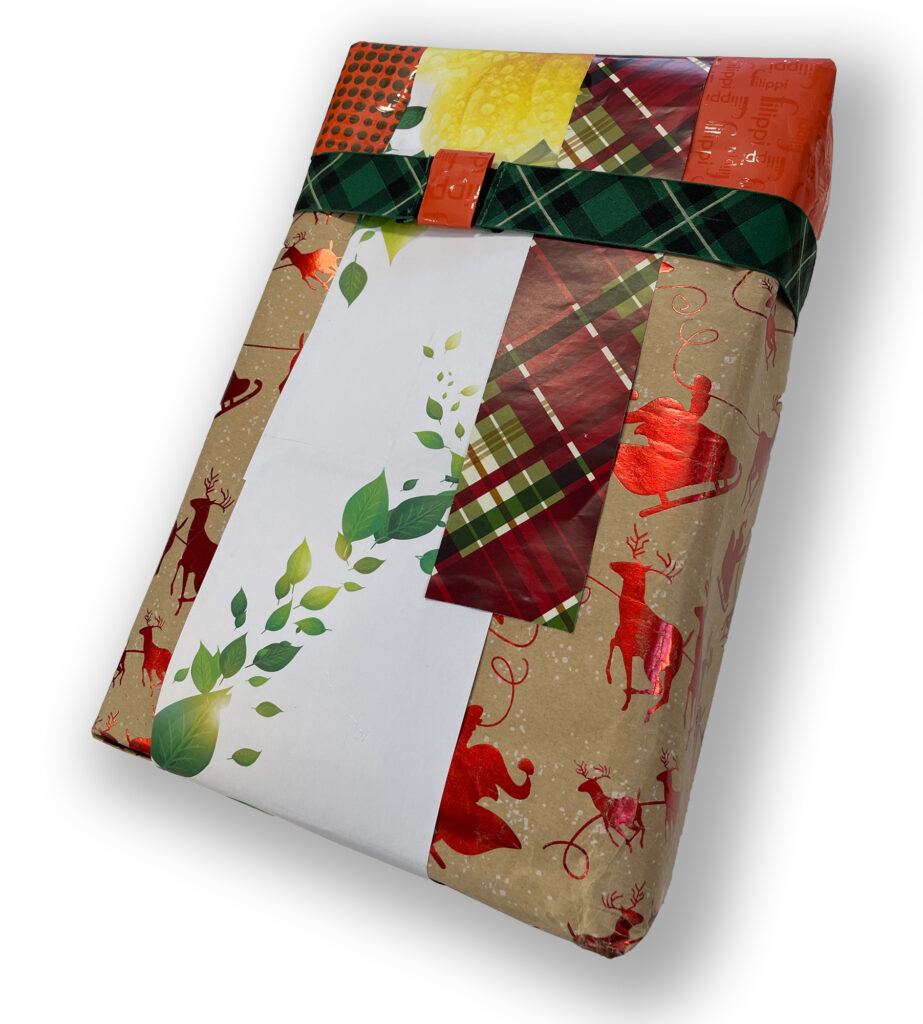
One of the most useful principles of scrap wrap is the “messy backstage.” There are six sides to a typical gift box: 1 back, 1 front, 2 end-folds, 2 plain sides. A wrapped present will normally rest on its back. That side is hidden from view. By permitting this area to be messy, we give the process of wrap improv greater freedom and speed. Scrap wraps are easier when you can hide anomalies of fit and finish on the back.
In this particular wrap, however, something funny happened. The messy backstage began to look more engaging the simpler front side. Four fragments of paper and an elastic ribbon join in a lively constructivist collage.
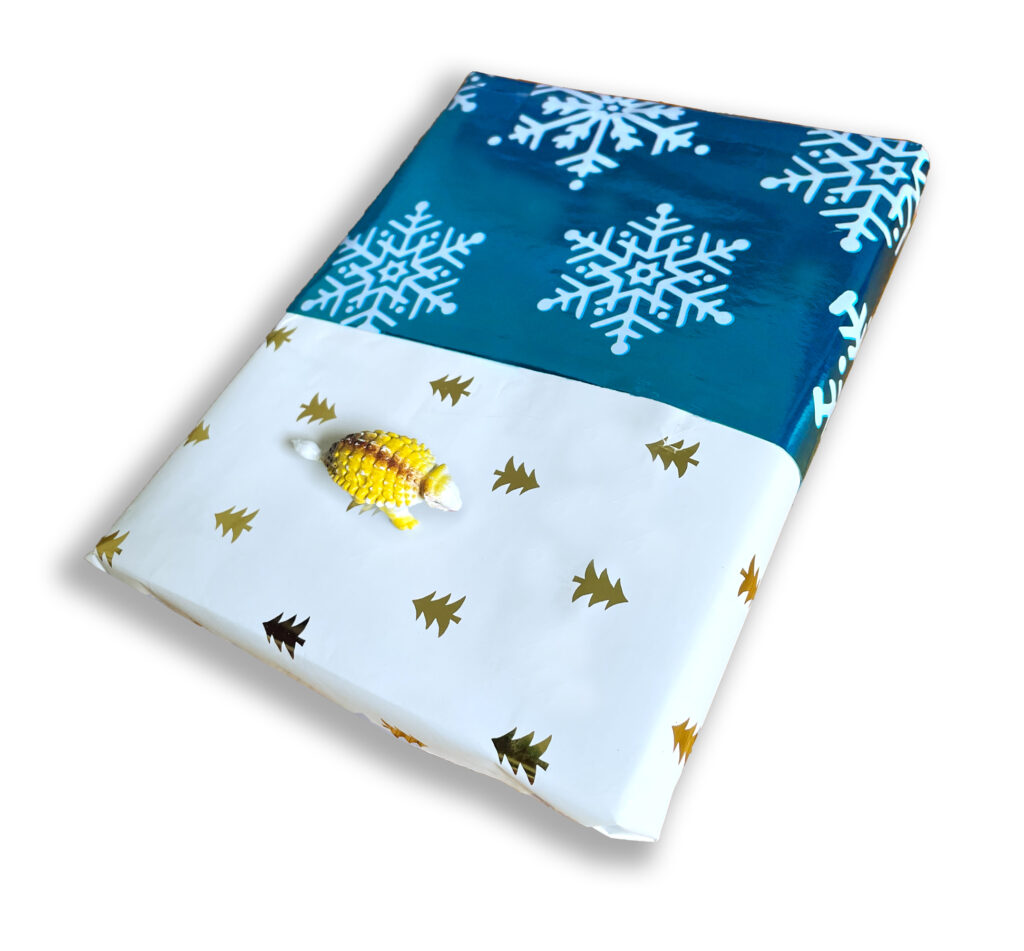
A very simple wrap for a very young recipient. Two foil paper fragments. Both use single-symbol graphic detail. But they contrast in brightness. One has a white background. The other is darker with blue. The mid-package join of the two papers is a simple folded edge. Foil papers are especially good at this. The finishing touch, its “bow,” is a small ankylosaurus toy, hot-glued onto the wrap.
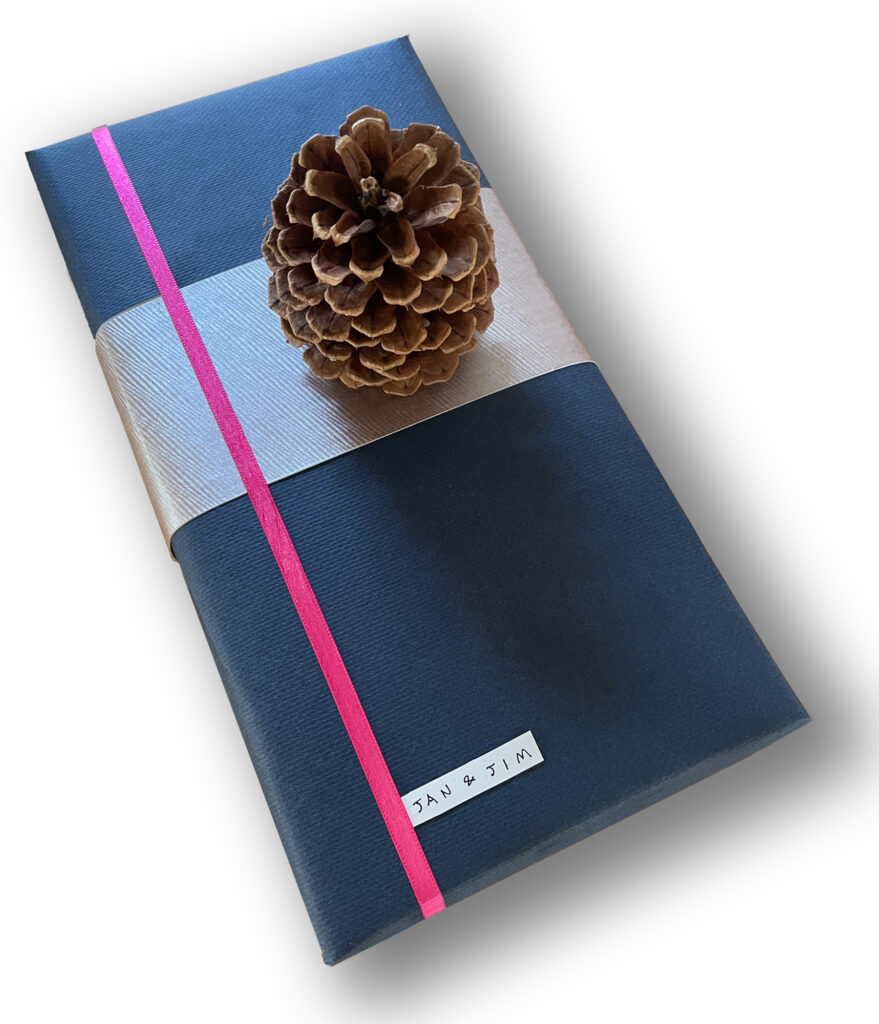
This wrap demonstrates the practicality of two-piece wrapping. I had two pieces of the blue paper. Neither piece was large enough to cover the present’s box. I wrapped the two pieces on either end of the gift’s box, with traditional folds on the ends. That left a raggedy unwrapped section in between the two blue sections. Following the protocol of two-piece wrapping, I covered that messy area with a wide band of thick silver paper. Its metallic texture contrasted nicely with the non-glossy texture of the blue paper. I positioned this band so that its lower edge aligned with the vertical middle of the gift box, creating a blue square on the bottom and a half-silver half-blue square on top..
I had planned that this wrap would feature a pine cone. I had just picked up four freshly fallen cones during a recent and very windy hike in the foothills. Before I glued the cone in place I studied the possibilities of placement for the magenta ribbon. I avoided centering it. Instead, I picked a location for the pine cone to right and then placed the ribbon centered between the cone and the left side of the package.
The last step was to make and place a tiny name tag for the recipients. They are custom shaped and made be an integral part of the design.
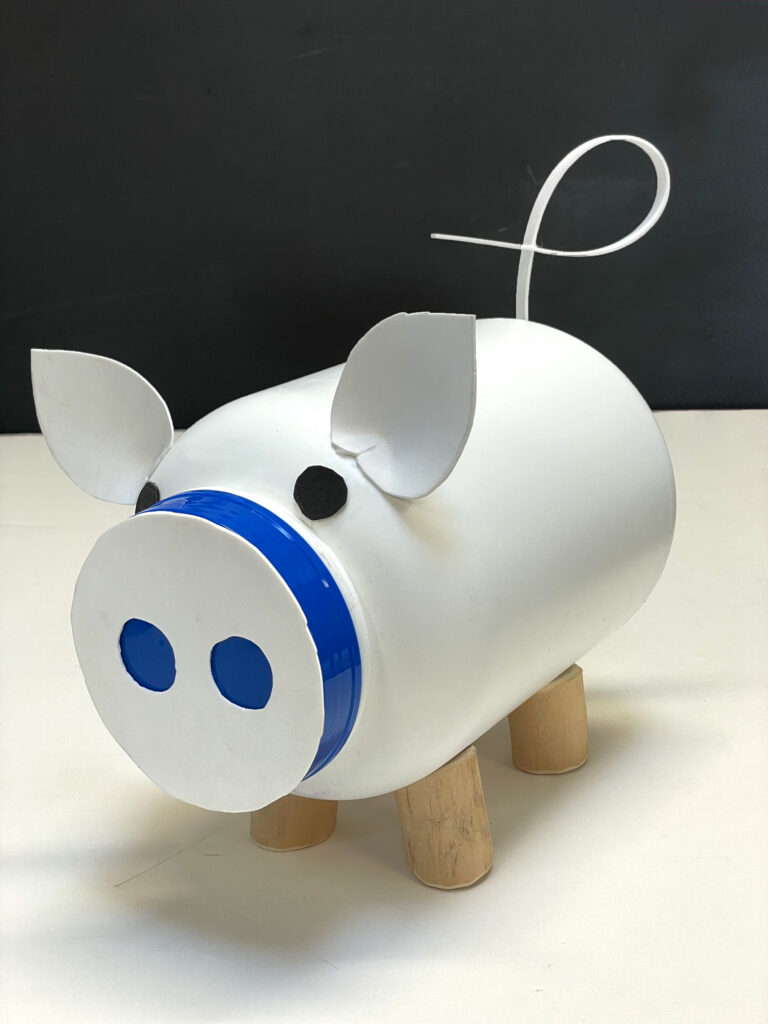
I had been thinking about this wrap in early November. I did not even know who would receive it let alone what gift would be placed in it. But I would imagine a pig whenever I laid the white plastic jug it on its side.
The first task was the hardest. I made four legs from a piece of a thin aspen that beavers had chewed down. I cut them with a saw and shaped them. Hot-glue attaches them to the white jug. Next came the snout. I used my circle cutter on white craft foam. I then referred to a test drawing and cut the two nostrils into the foam circle. I glued this onto the blue cap of the jar.
Next I made ears, using paper test models first to get the shape right. The bottom of the ears is a folded rectangle with a triangular cut out. That cut out permits an entire ear to curve ever so slightly as the two sides of the triangular cut-out meet during glueing. That bend-and-join makes the ears softly rounded and it also keeps the ear standing up. The eyes were simple: dots of black craft foam.
Last of all was the pig’s tail. I looked up pig images and found out that a single curl with one overlap was all most pigs had in their tails. No need for cork-screw spirals. A dot of glue held the curving tail in place as it crosses itself once. A tiny triangle of white foam placed where the tail attaches to the pig made the tail offset at an angle, offering good views from many viewpoints.
A few days before Christmas I thought of the gift that would agree with this novel scrap wrap. I had seen it on a shelf in my studio. It was an old beer bottle with a labels that I had designed a long time age for my geologist brother’s home brew: “Mud Lager.” The name plays off the oil drilling job of the person who logs drilling mud for its information: mud logger. The slogan: “When you’re having a blowout, don’t forget the mud logger.”
This wrap has the benefit of a screw-on cap. It can thus be used for a variety of occasions long after the gift has been given.
I have so many small boxes that I felt it would be a good idea to design wraps that used this surplus. The gift is in the largest box. It is wrapped with a page from a museum newsletter. The two added boxes are attached to the primary box. The littlest box, with a red foil surface and black angled stripes, serves two purposes. It is the name tag for the recipient. And it is a handle attached to the top white middle box. That white box has no wrap, and the offset of its lid is obvious. When you grab the black striped “handle” the white lid lifts off, revealing a curled white strip inside telling the recipient that the gift is inside the bg box. Silly, yes. But hopefully of some charm.
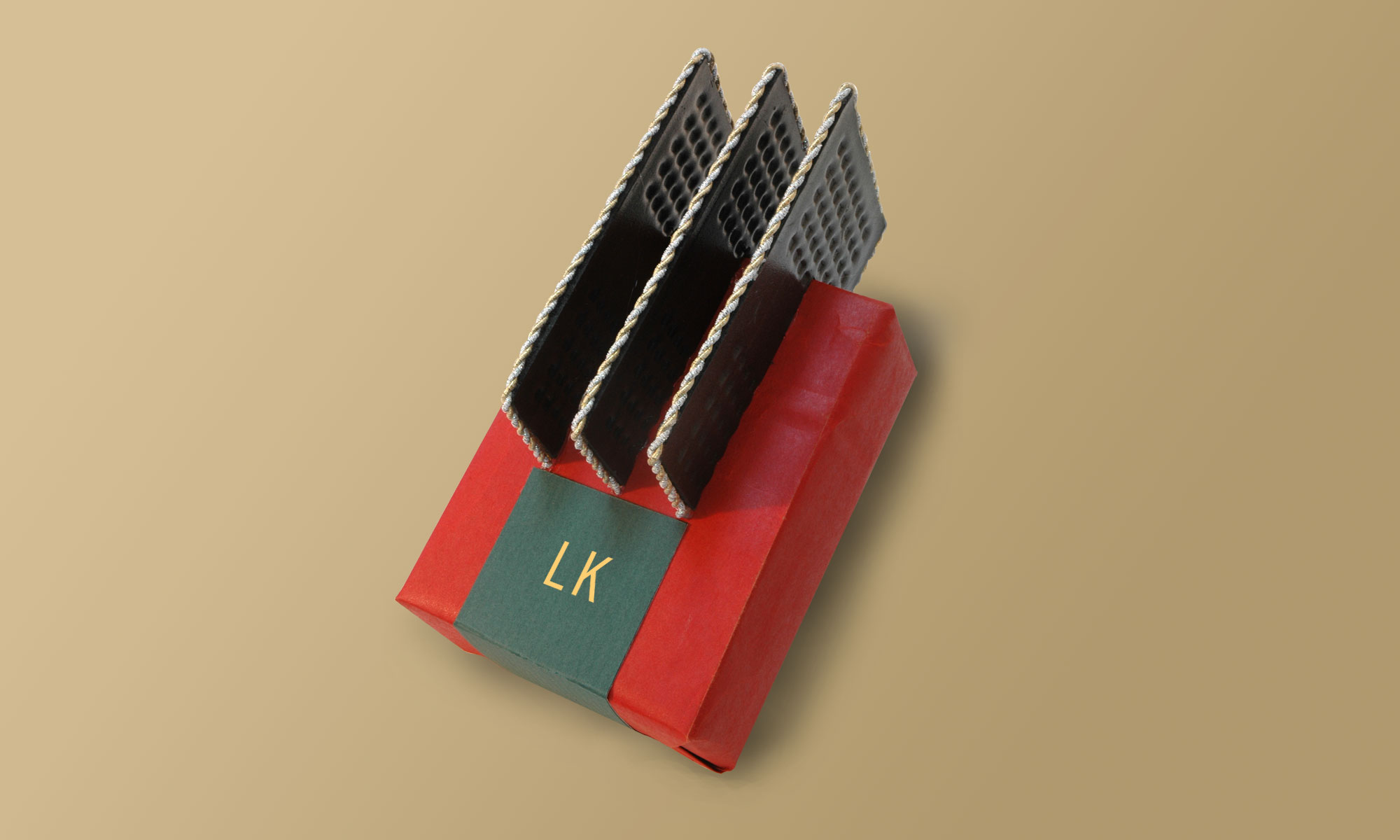
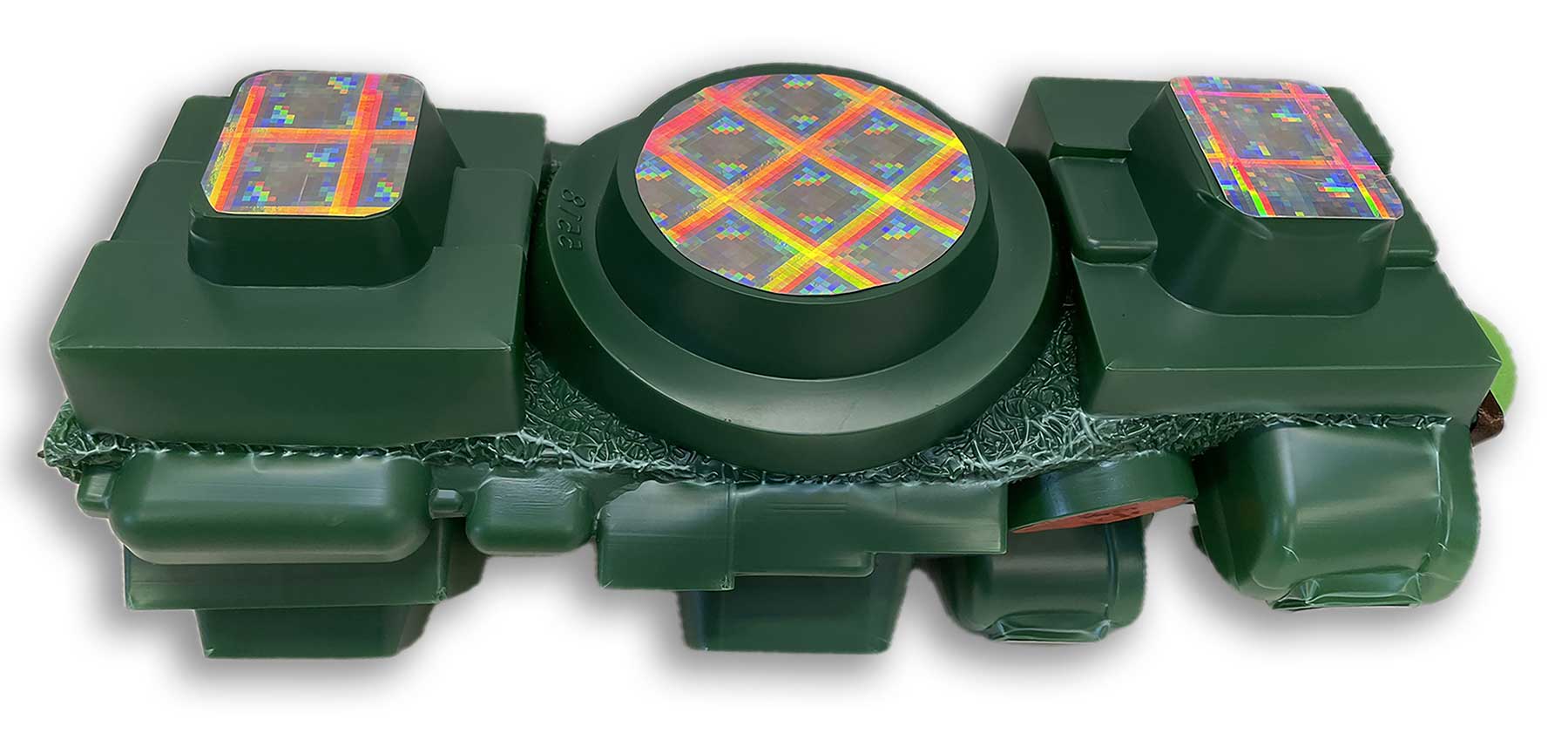
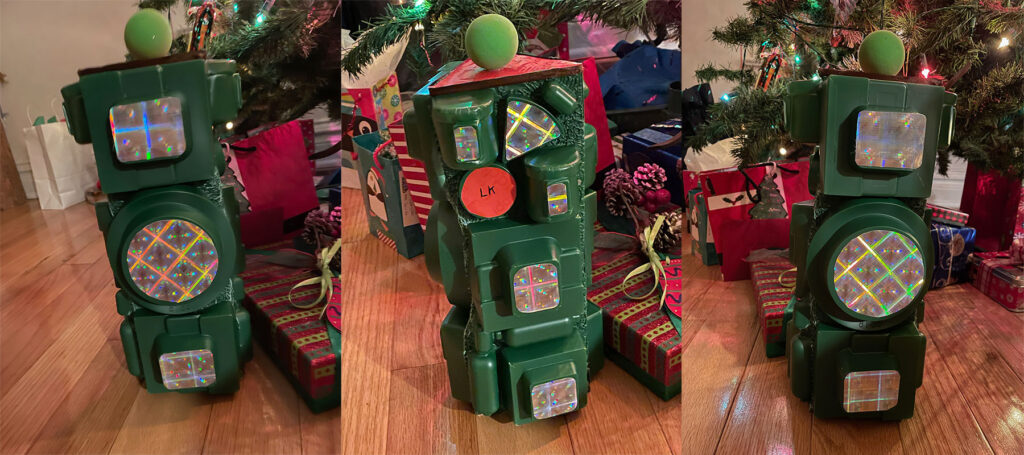
We had received a Christmas food gift from my brother & his wife. A green plastic tray held all the goodies in place in little pockets of vacuum molded soap. Playing with the intriguing topology of this object I discovered that it could be folded in thirds king a triangular column.
When I had the chance to turn into wrap art I tied it and hot-glued it closed, joining the outer edges of the three panels. I made triangular paper inserts out of stiff paper that fit into the top and bottom of the plastic box. I placed the gift inside and padded it with two foam scraps to preclude any motion motion of the gift.
Now it was time to consider what to put on all the various flat platforms that arose from the three sides of the plastic form. I visited the ribbon closet and found a square cardboard envelope which had a holographic surface in a gridded pattern. When one views this materials from different angles, spectrum color shifts occur in the little squares of the paper’s pattern. There is almost constant animation. I began cutting squares, and triangles of this paper, fitting them on the various protrusions populating the green triangle-tube. Where cookies, chocolate, sausage, and cheese once lay in waiting, the container now popped out with these small dynamic color generators. To the eye they simulate little digital screens.
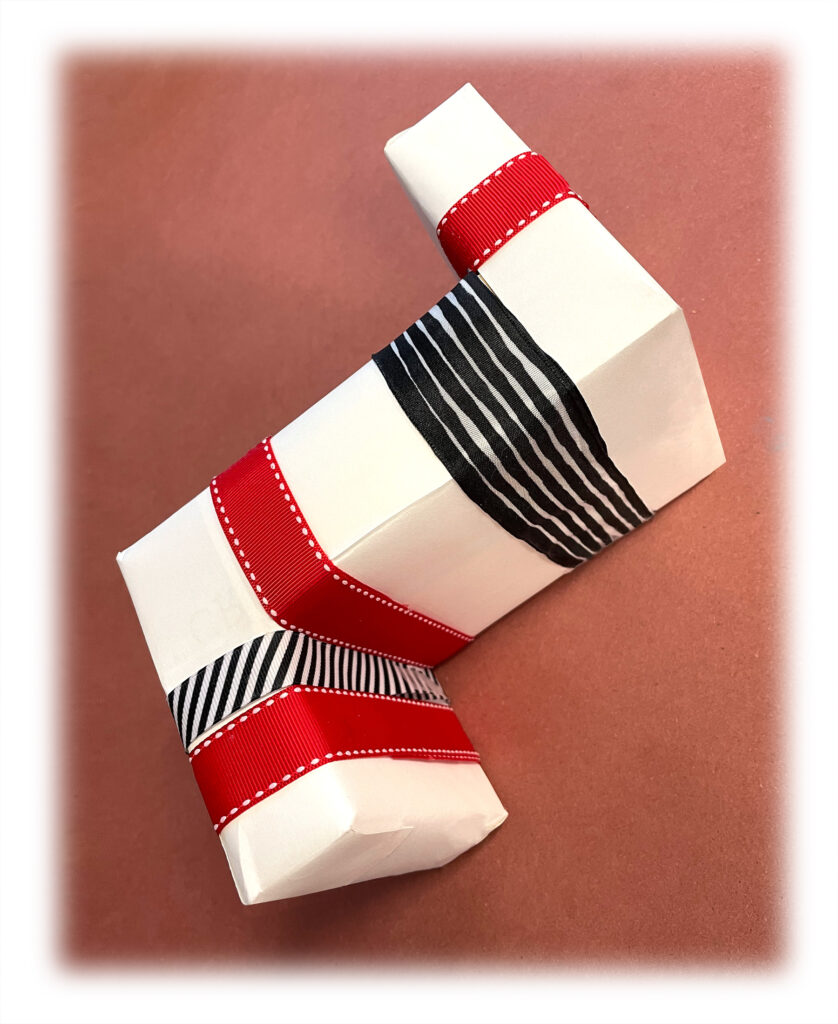
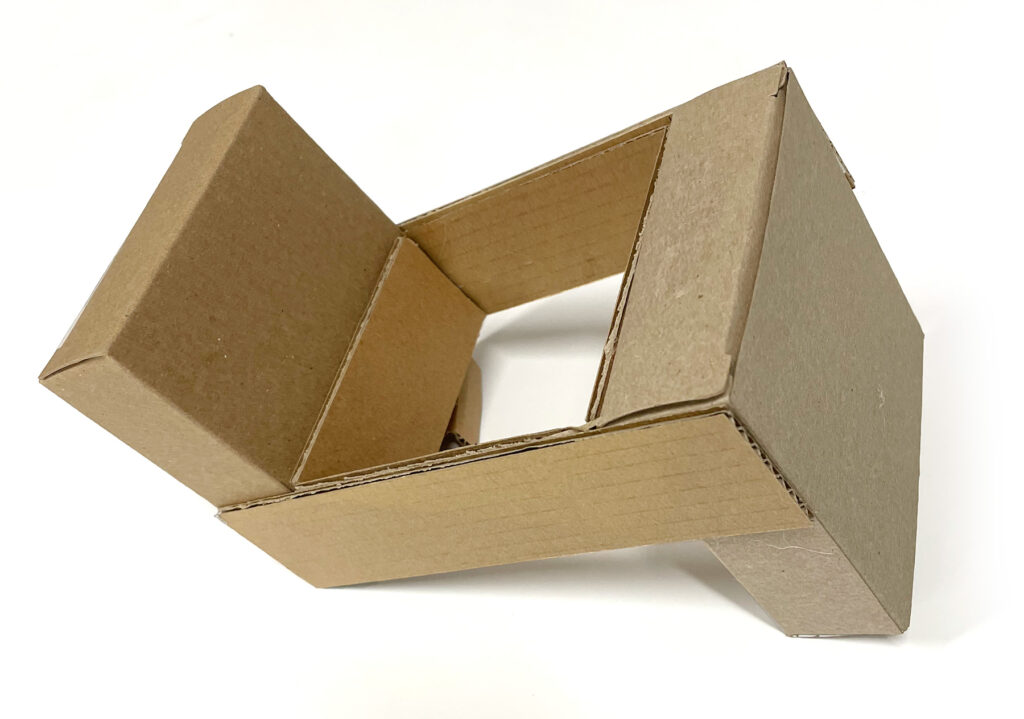
I had two small boxes, about the same size as the he gift I wanted to wrap. They suggested to me the idea of making an irregular shaped “giftbox.” I set about to make a special skeleton out of the two boxes, linking them with beams of corrugated board, The gift fits right inside the space between the two boxes and their beams.
Extra pieces of board made the gift fit snug in order to make the task of wrapping this odd shape a bit easier.. Admittedly the task of wrapping this conglomeration in white paper was not that easy. I knew that there was no easy way to wrap this zig zag box with a single piece of paper. So I collaged it with numerous pieces of scrap 8.5″X11″ stationery. I used both thin tape and a bit of hot glue. Finally I had a solid white wrapped zigzag. I added three red ribbons one kind of red ribbon, and two pieces, of varying pattern black and white ribbon. I made the label out of small gray and very flat beach beach pebble. I inscribed the name with a marker.
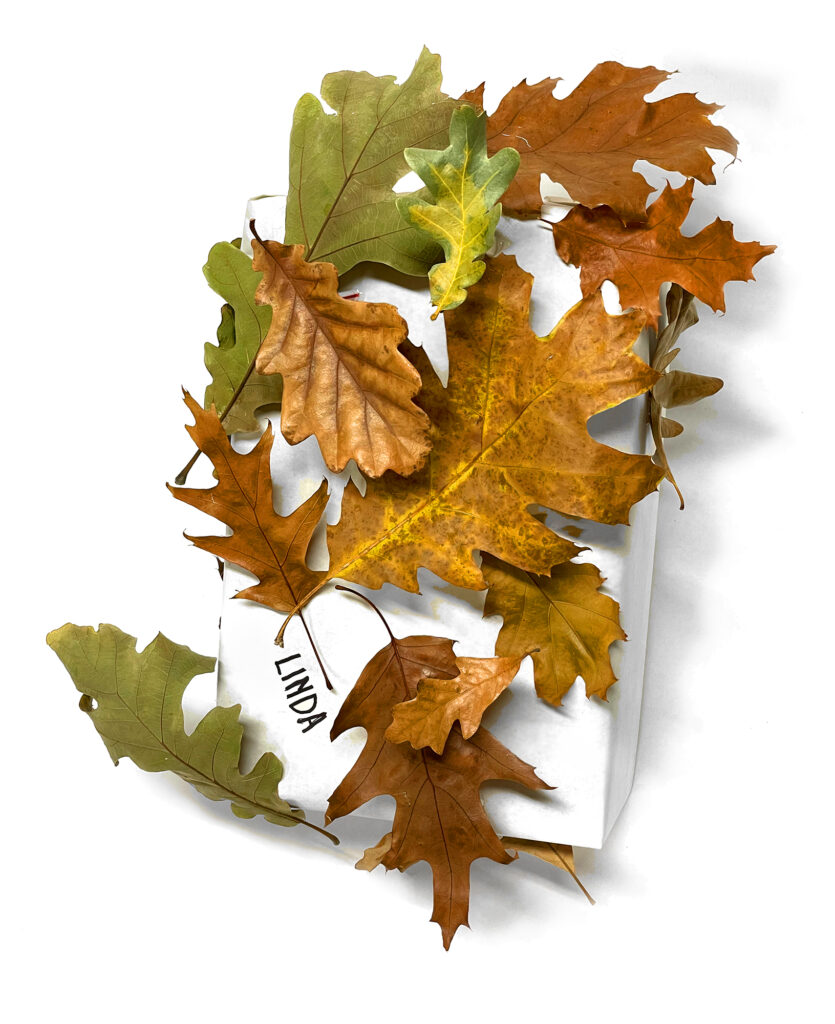
I love the dried leaves that carpet the autumn pathways. I began preparing for this wrap a while ago. And I added new leaves right up to the day I made this wrap. I have used large green leaves in the past. They can be shaped to the package. But what would allow me to use brittle dried leaves. I decided that I would try foam stilts to lift them free of the underlying wrapped box. I cut short pieces of white foam and hot-glued them onto individual leaves. When they cooled and were stable I trimmed the bottoms to make them stable and free-standing with three legs. Then I glued them onto the white-wrapped gift box. I added some that had only two legs, raising them higher that the initial batch of leaves so that the collage had a feeling of being airborne. Eventually there were enough to call it a finished composition.
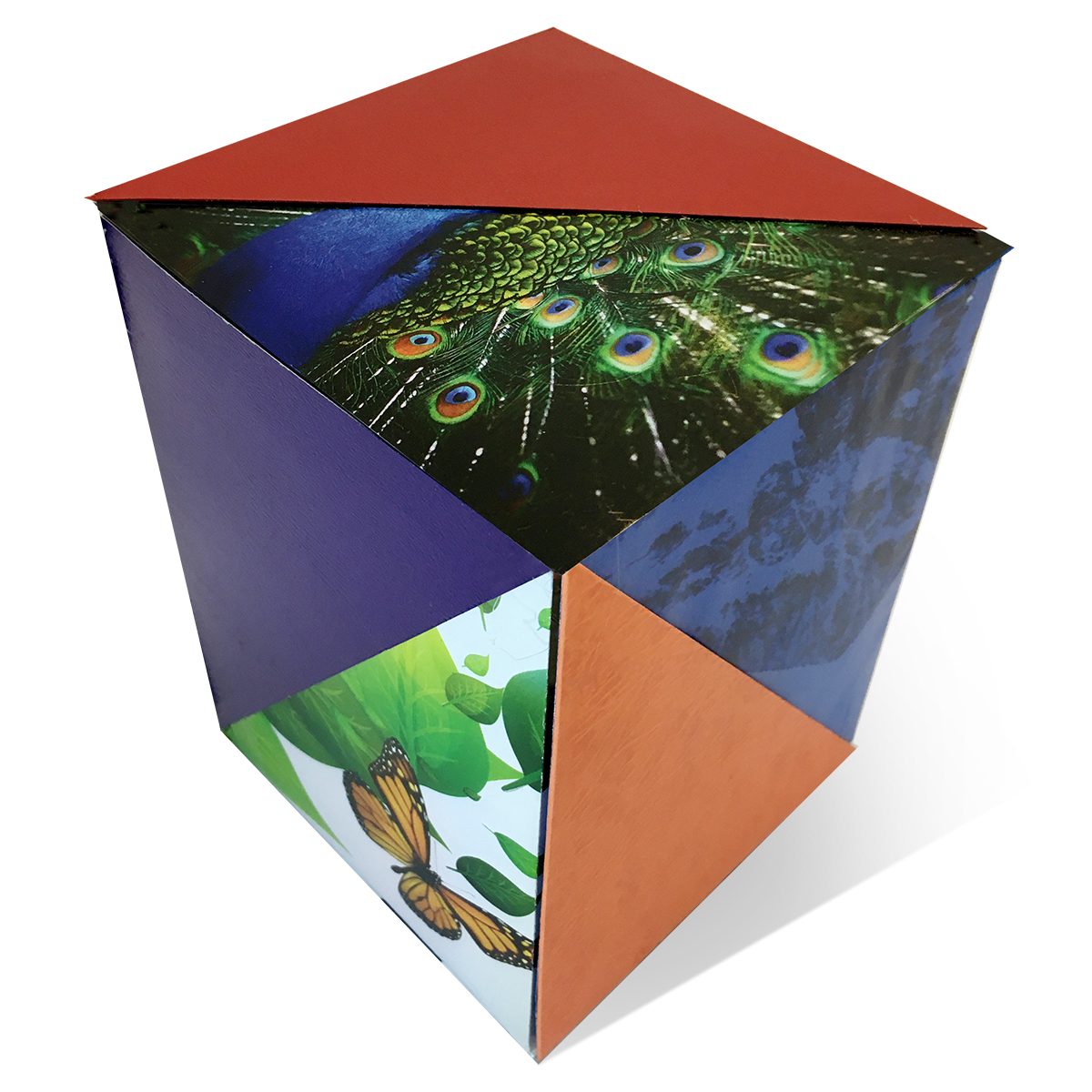
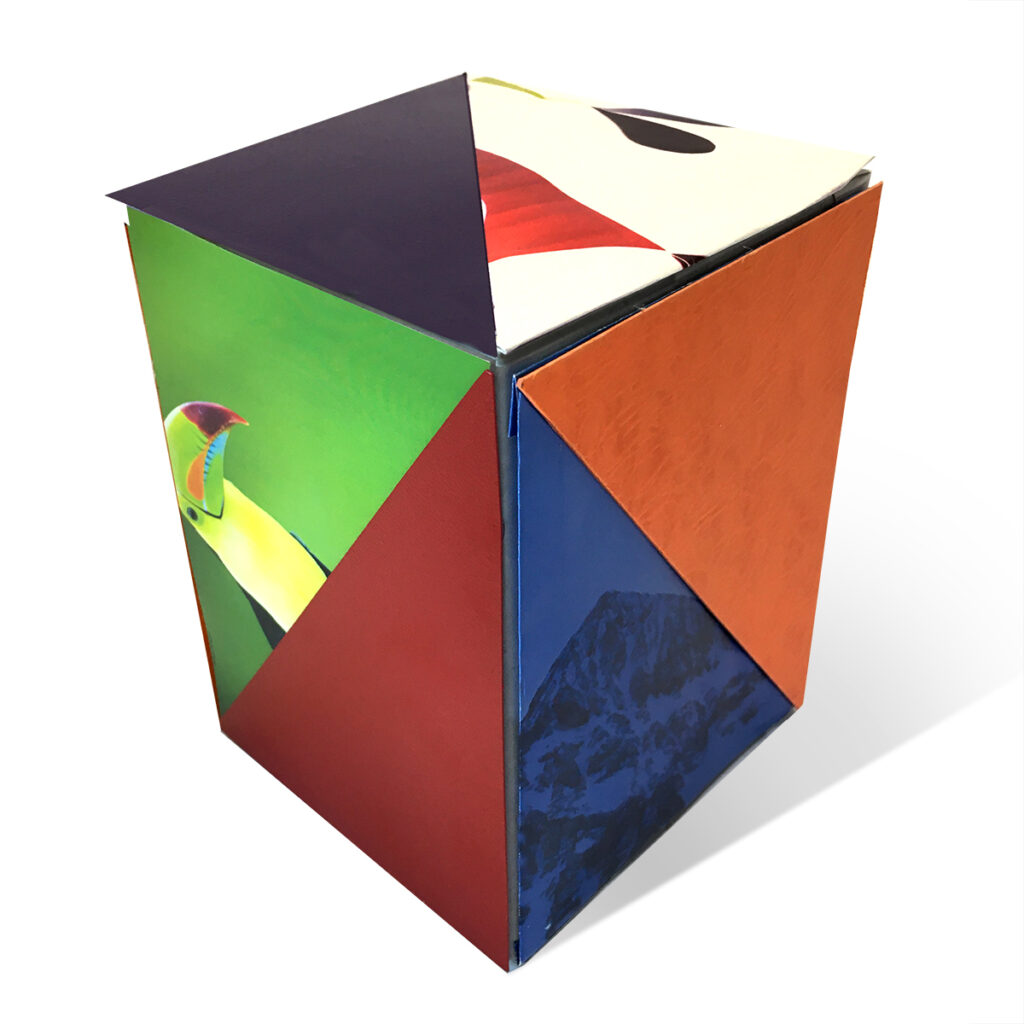
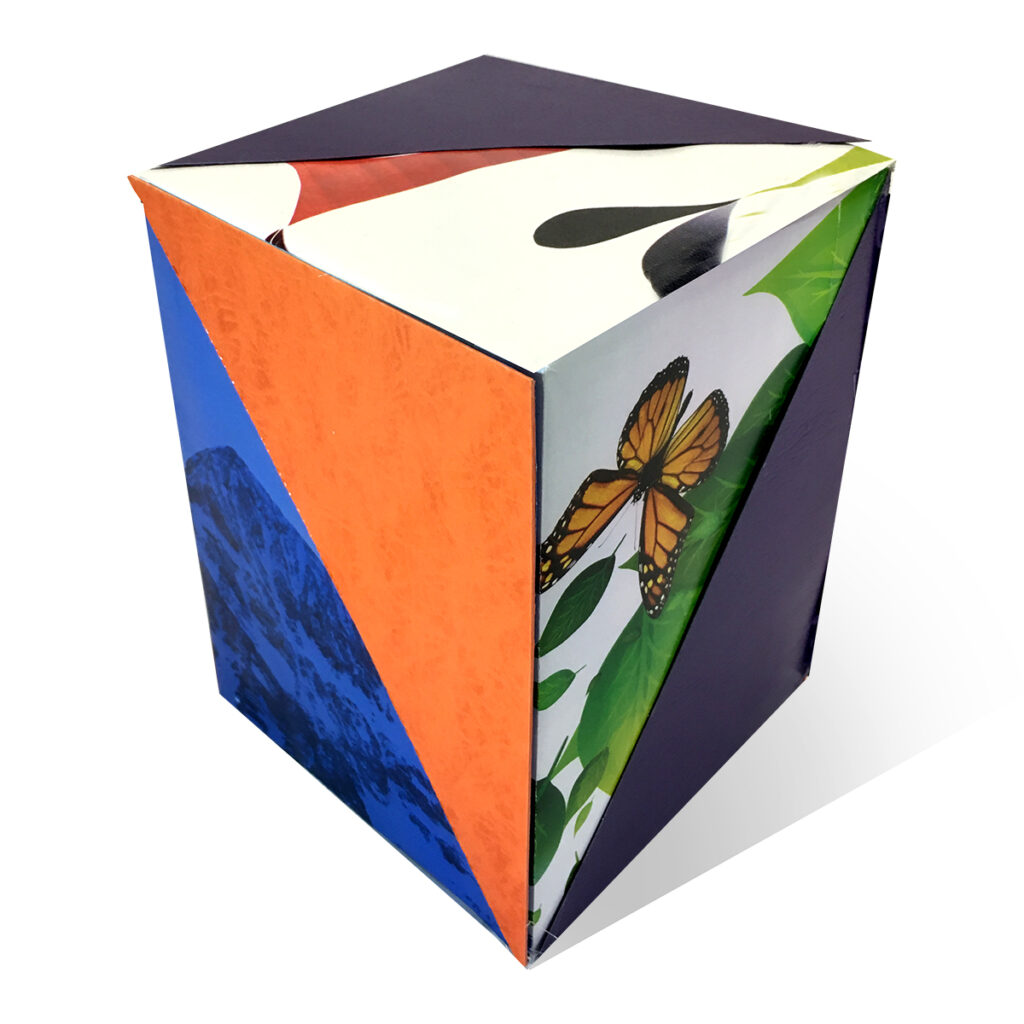
This is an example of accretive wrapping. It starts with a “base coat” of plain paper, applied in the traditional way: a single piece of paper wrapped, with two folded ends.. The first layer of accretion consists of six separates rectangles of imagery taken from magazines and marketing literature.. I cut them out to fit the six sides of the gift box, gluing or double-taping them onto the base wrap. Then I cut and fitted six triangles of stiff paper from printer’s paper samples. These are all glued on the image layer. The wrap can rest on any of the six sides. All views of this wrap are good.
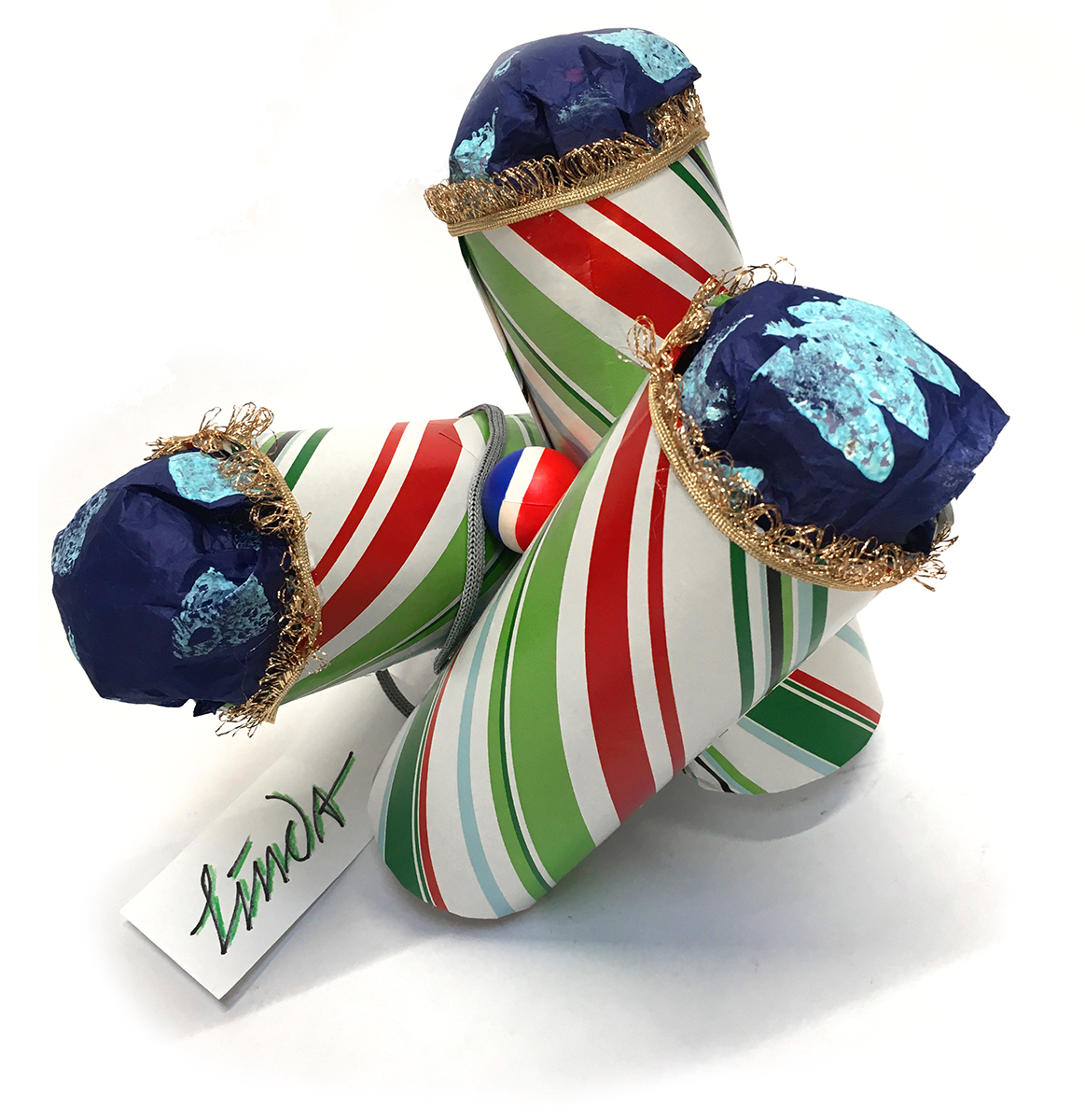
The gift had three parts. In the middle of the night I had the idea of conjoining three boxes. In the light of day it became three tubes. The engineering was challenging. Since the three tubes were to be covered with wrapping paper scraps, I had to figure how to join them without relying on the flimsy wrapping-paper skin as a structural gluing surface. So I drilled holes in the sides of the tubes. I hot-glued six 1″ dowels into the holes. Then I wrapped the three tubes with striped wrapping paper scraps, and then completed the task of gluing three tubes together using their various dowel pegs and holes. It was not easy, and I do not recommend trying this wrapping strategy with angled cylinders. But it did finally come together. I plugged the lower ends with cardboard cross beams and inserted the three gifts into the upper opening of the tubes. I stuffed those upper ends with blue tissue, and added the gold ribbon trim, to give that completing note of wrapping tradition to this non-traditional wrap. When placed amongst wrapped gift boxes it has it own peculiar presence.