Knife Wrap

knife wrap

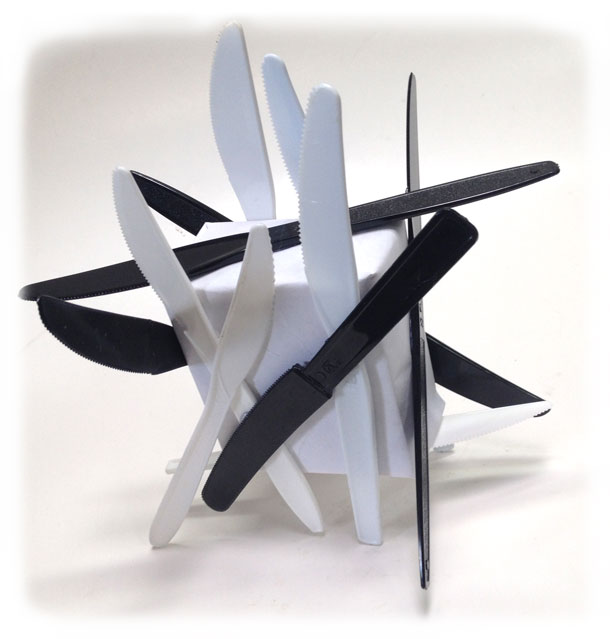
While cleaning the kitchen one day, I consolidated an excess of plastic knives, spoons and forks. The beauty of multiples forced me to save them in plastic bags. The knife bag went into my wrap warehouse.

On Christmas day my son was attending to his last-minute wraps, and I volunteered to wrap one of his smallest presents.

I gave it a white-paper wrap and then began gluing plastic knives onto the box. I looked upon them as lines or strokes, and began creating a constructivist composition of angles. I had planned, and still do plan, to glue on a lot more of them. But we ran out of time and so this was my wrap. The dense-pack knife wrap awaits some future opportunity. In the meantime, the relatively sparse application of knives works quite well, and perhaps better honors its derivation in Russian artists.

Zen Table Wrap

zen table wrap

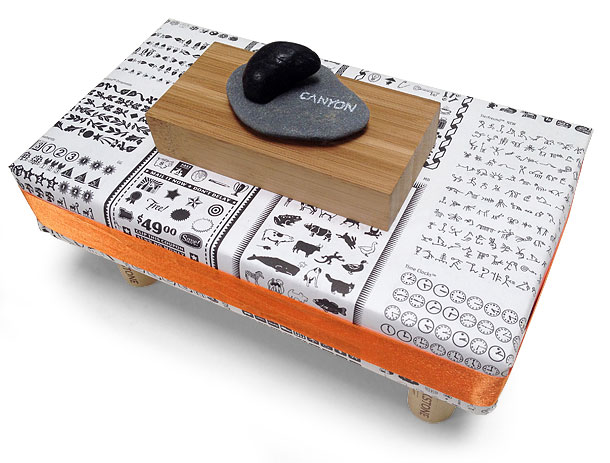
The wrap began as I rummaged through my wrap paper drawer and discovered an old type catalog, “X-Height.” It’s tall large page size, each page with a grid of square type samples, offered a paper suitable for small boxes, and one that was rich in non-repeating graphic forms.

I wrapped the present. However, the end folds did not quite cover each other, so I reached into the ribbon box, and retrieved a wide orange ribbon. I like to use ribbon on the small sides of a wrap; it provides more color and a texture change, but it leaves the stage empty for sculptural play.

Next I glued on four wine-cork legs. Raising a wrap on legs has an amusing and quietly transforming effect on any gift. The resonance with tables and benches lifts the wrap away from the metaphor of storage or inventory and places it into the non-wrap realm of furnishings.

At this point I did not have to place anything on this table.  The paper’s symbol-filled square were amply entertaining. But I was having fun, and began to play with the variety of wood and rock materials cluttering my studio. A pedestal of sample engineered bamboo felt good sitting on the type-sample wrap. I then tried numerous rocks and twigs until I finally settled on the flat gray “label” rock and its companion, a shiny black rock. I added the name of the recipient in white colored pencil, and glued all three pieces onto the table wrap.

Scrappy Materialism

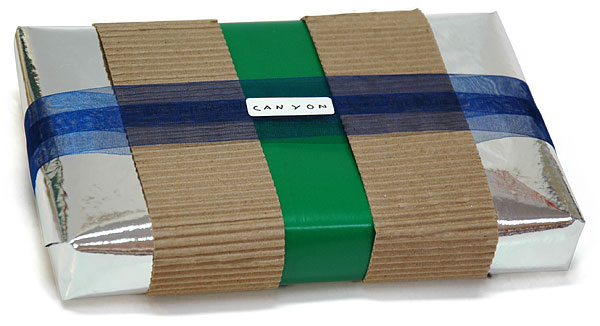
Coffee-cup insulators are made of a delightful small-scale corrugated paper. I think of it as the elegant cousin of the corrugated cardboard that so much of our gifts travel about in during their busy lives, before and after wrapping.

This wrap sought to integrate that material into the vocabulary of wrap. I thought some scraps of silver paper constituted a perfect contrast to the flat, plain color and dimensional complexity of the coffee cardboard. I wrapped the ends of the gift with two pieces. I added some solid green, contrasting in darkness and low reflectivity to the silver. Then I added the two bands of cardboard.

Blue gauze ribbon, placed in wrap’s traditional 90-degree style, brings yet another note to our chord of textures. I did not want to cut the ribbon scrap, so I overlapped it with an offset, emphasizing its transparency and gaining two additional visual lines in that plane.

The name tag is an office-supply folder label.

Round Wrap in Pie-bin Bottoms


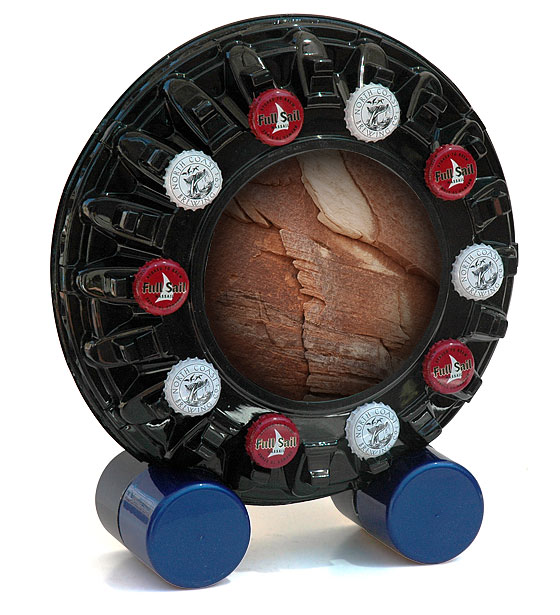
Pies from our Whole Foods come in marvelous molded-plastic containers. Put the bottom halves from two of them together and you have a strange round device that resembles some kind of off-road tire, or perhaps the base form of a dark space ship.

Those two pieces of black plastic are glued together using 1-inch-long pieces of popsickle sticks. They are hot-glued into little slots conveniently located around the molded shape of the pie-bin bottoms

I next made the feet for this wrap using four lids from aerosol deodorants. Their plastic is metallic adding more machine aesthetic to this peculiar wrap.

I glued a sequence of bottle caps on ten of the twenty raised knobs that ring the pie bottoms’ flat central circle, adding to the visual theme of circles. Their detailed design and printing enriches the design by bringing a finer level of detail to the complex but larger forms of the black plastic.

It actually took a while to figure out what to put in that central, flat circular space. I cut out various magazine-ad photographs and also fragments of wrapping paper and art paper. Nothing seemed to be compelling. I finally decided to use my own photography. I made a circular crop of a photo I took last week while hiking in the Comb Ridge of southern Utah. I added a black “inner glow” in Photoshop. I printed it, cut it out and glued it into the circular recess.

In order to spare the recipient the potential anxiety of having to destroy such a curious sculpture, I cut out the circular recess on the back side and made it into an access door closed with simple tape fixtures.

Numinous Trashformation

An amazing quantity of exotic materials flows through our households every day.

As a part of 1) my quest to divert some of the more charming of these objects away from the dumpster and 2) my need to reduce the volume of my in-studio recycling bins, I made this wrap.

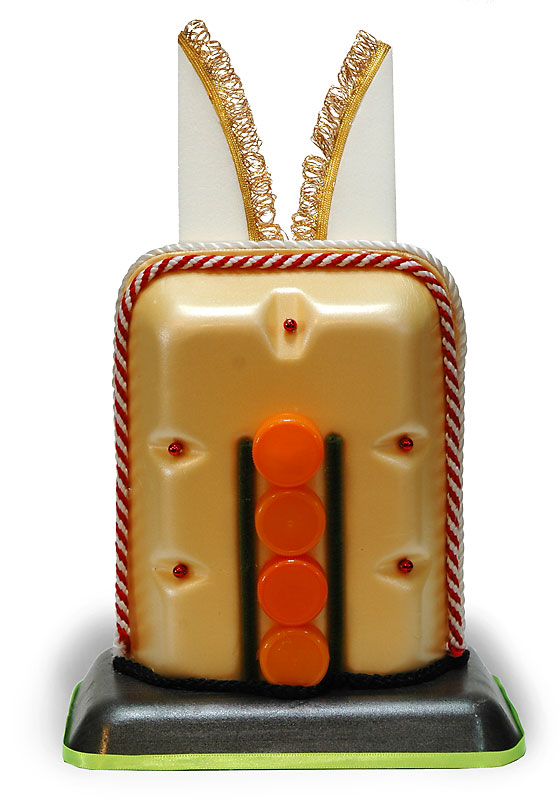
I started with a long yellow foam tray that once held chicken breasts. I cut it in half and glued the two halves together. That leaves an almost-closed box; only the bottom is open.

Resolving to solve that later, I began to trim out the yellow box. The edge where the halves join I covered with a white cord taken from a shopping bag. I then glued dark-green chenille stems into vertical depressions in the foam tray. I glued orange-juice caps in a column between the stems. I clipped small shiny red beads from a scrap of bead-cord and glued them into the eye-shaped molded depressions in the foam tray.

After a bit of testing, I chose another foam tray for the base. I trimmed off the lip that runs around its edge and glued on a scrap of lime-colored ribbon. Then I placed the gift inside the yellow shell. I made a door in the base foam, so the gift could be removed without destroying the wrap; I taped the door shut. I glued the two foam objects together.

I was not yet ready to stop. The wrap seemed to want more. I glued a piece of black bag-handle  cord to the join between black and yellow foam. Adding these extra components have a powerful effect. The identity of the foam as food-packaging trash begins to recede, and the underlying power of the foam’s native form and its beautiful qualities asserts itself.

Thus inspired I took a single scrap of thick white foam from my tiny-foam-scraps bag. I cut it in half and had two Cycladic ears (c.f. church architecture of Santorini), which I glued to the top of the wrap. Picking up conceptual momentum, I added the red/white bag-handle cord. And I added the gold fringe ribbon to the ears.

I stood back and contemplated the wrap. It had a new and mysterious appeal, all its own, of numinous packaging.